
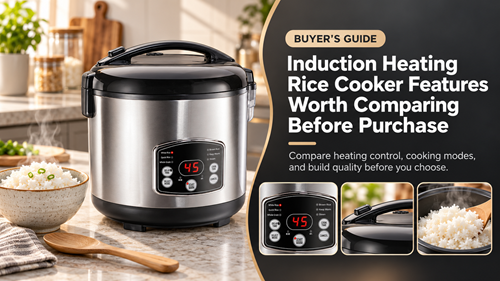
Induction Heating Rice Cooker is most useful when the decision starts with the normal batch, the grain or meal being cooked, available counter space, cleanup, and how often the feature will actually be used. The headline specification matters only when it improves a real household routine.
For rice cooker shoppers, home cooks, premium appliance buyers, families, and people comparing heating systems, the goal is not to collect the most functions. It is to identify a cooker that delivers repeatable results without unnecessary capacity, complicated maintenance, or controls that are rarely used. Check the exact manual and current model listing whenever a setting, material, capacity, or care instruction differs from general guidance.
How To Evaluate Induction Heating Rice Cooker
Start with one normal use case for the Induction Heating Rice Cooker: the quantity cooked most often, the people served, and the time available for setup and washing. Comparing appliances without a baseline makes a larger pot or longer feature list look more useful than it may be.
Separate core cooking performance from convenience features. Heating, pot contact, sensors, pressure, and supported programs determine the cooking process; timers, displays, warming, and accessories determine how the appliance fits the day. Both matter, but they solve different problems.
Finally, compare ownership details. Check lid parts, steam paths, replacement inner pots, measuring cups, cord storage, warranty support, and the vertical space needed when the lid is open. These details often determine whether a cooker stays in regular use.
Induction Heating Rice Cooker Features And Buying Checks
IH Rice Cooker
IH models heat the cooking vessel through an induction system rather than relying only on a conventional bottom heating plate. Compare the exact manufacturer design because control methods differ between product lines. Compare the exact model specification and the way this feature changes capacity, control, cleanup, or daily workflow before treating the phrase as a reason to buy.
For a concrete reference, review IH rice cooker and compare the exact capacity, controls, materials, or instructions with the appliance you are considering. Use the linked page as one data point, not as a substitute for the current model manual.
Induction Temperature Control
Temperature control is useful when it supports the rice and grain programs the household actually uses. A premium control system does not remove the need for accurate measurement and the correct program. Compare the exact model specification and the way this feature changes capacity, control, cleanup, or daily workflow before treating the phrase as a reason to buy.
For a concrete reference, review induction temperature control and compare the exact capacity, controls, materials, or instructions with the appliance you are considering. Use the linked page as one data point, not as a substitute for the current model manual.
Stainless Cooking Bowl
Inner-pot construction affects heat transfer, weight, cleaning, and replacement cost. Stainless components can be durable, but many IH cookers use layered or coated vessels rather than a simple bare-steel bowl. Compare the exact model specification and the way this feature changes capacity, control, cleanup, or daily workflow before treating the phrase as a reason to buy.
For a concrete reference, review stainless cooking bowl and compare the exact capacity, controls, materials, or instructions with the appliance you are considering. Use the linked page as one data point, not as a substitute for the current model manual.
Even Heat Rice Cooker
Even heating should be evaluated by repeatable texture across the batch, not by the marketing phrase alone. Test the normal quantity and compare edge, center, and bottom texture. Compare the exact model specification and the way this feature changes capacity, control, cleanup, or daily workflow before treating the phrase as a reason to buy.
For a concrete reference, review even heat rice cooker and compare the exact capacity, controls, materials, or instructions with the appliance you are considering. Use the linked page as one data point, not as a substitute for the current model manual.
Premium Rice Maker
Premium pricing may include induction, pressure, voice prompts, specialized menus, or heavier pot construction. Decide which features reduce a real household problem before treating the higher tier as automatically better. Compare the exact model specification and the way this feature changes capacity, control, cleanup, or daily workflow before treating the phrase as a reason to buy.
For a concrete reference, review premium rice maker and compare the exact capacity, controls, materials, or instructions with the appliance you are considering. Use the linked page as one data point, not as a substitute for the current model manual.
Six Cup Rice Cooker
A six-cup class can suit families and meal prep, but minimum batch size still matters. Compare the quantity cooked most often with the model’s practical range and included measuring cup. Compare the exact model specification and the way this feature changes capacity, control, cleanup, or daily workflow before treating the phrase as a reason to buy.
For a concrete reference, review six cup rice cooker and compare the exact capacity, controls, materials, or instructions with the appliance you are considering. Use the linked page as one data point, not as a substitute for the current model manual.
Induction Heating Rice Cooker Comparison Table
Use the table as a short decision screen before comparing prices. The exact manufacturer specification takes priority if a model defines capacity, programs, materials, or care differently.
| Decision Point | What To Compare | Why It Matters |
|---|---|---|
| Heating system | IH coil/control design | Affects how heat is delivered |
| Inner pot | Layered, coated, stainless components | Affects weight, care, and replacement cost |
| Programs | White, brown, mixed grain, specialty modes | Buy only useful control |
| Capacity | Minimum and maximum practical batch | Avoid oversized premium hardware |
| Maintenance | Lid, steam vent, sensors, pot | More complexity can add cleaning steps |
How To Test And Use Induction Heating Rice Cooker In A Real Routine
Before deciding that a feature is useful or that a cooker is too small, run one controlled test with the actual rice, water, measuring cup, and batch size you normally use. Keep the variables stable so the result can be compared fairly.
Pre-Purchase And Setup Checklist
- Compare IH with a non-IH model at the same capacity
- Confirm pot material and replacement cost
- Check supported grain programs
- Read minimum batch guidance
- Inspect lid and steam-path cleaning
- Review power requirements and cord placement
- Check warranty and service availability
- Test one familiar rice variety first
After the test, note what you would change next time. Adjust one variable at a time—water, batch size, program, rest time, or accessory timing—rather than changing several settings together. This produces a repeatable household method instead of a one-off result.
Mistakes That Change Rice-Cooker Results
- Buying induction solely because it is labeled premium
- Assuming a stainless component means the entire pot is bare stainless steel
- Ignoring replacement-pot cost
- Comparing maximum capacity without checking minimum practical batches
Manual, Food Safety, And Care Reference
For appliance-specific limits, the model manual remains the final authority. For food handling after cooking, review USDA leftovers and food-safety guidance and keep hot-holding, cooling, refrigeration, and reheating decisions separate from the cooker’s marketing claims.
Allow the appliance to cool before cleaning unless the manual says otherwise. Keep electrical bases dry, clear steam vents as directed, and use only approved utensils or cleaners on coated inner pots. Stop using damaged cords, warped pots, broken latches, or unusual electrical components until the manufacturer or a qualified service provider confirms the next step.
Choose Induction Heating Rice Cooker For The Routine You Actually Have
A useful Induction Heating Rice Cooker decision comes from matching the cooking system to a real routine. Capacity, pot design, supported programs, cleanup, counter space, and repeatable results should carry more weight than feature count by itself.
Compare the exact model, test the normal batch, and keep the manual available. A cooker that is easy to measure, start, clean, and repeat will usually deliver more value than a technically advanced model whose extra functions are rarely used.
Frequently Asked Questions
Does induction heating cook rice better?
It can provide more controlled heating in some designs, but results still depend on the model, pot, program, rice, water, and batch size.
Is an IH rice cooker faster?
Not always. Some programs may prioritize texture and control rather than the shortest total time.
Do IH rice cookers need special inner pots?
Yes, the cooker is designed around a compatible vessel. Use only the pot specified by the manufacturer.
Is six-cup IH capacity good for families?
It can be, but compare normal household batch size with both minimum and maximum model guidance.
Are induction rice cookers harder to clean?
The inner pot may be straightforward, while premium lids, steam paths, and pressure components can add care steps depending on the model.
