

Basmati rice rewards consistent rinsing, measured water, and heat control that preserves long-grain separation. The right rice cooker does not need a “basmati” button, but it should make the preparation routine repeatable and keep-warm behavior predictable.
The best rice cooker for basmati rice does not have to advertise a dedicated basmati button. Current fuzzy-logic models on the site already provide controlled white-rice cycles and consistent keep-warm behavior; the key is whether the cooker lets a repeatable rinsing, soaking and water routine produce the long-grain texture you want.
For a practical model connected to this point, see Panasonic 10-cup fuzzy logic rice cooker.
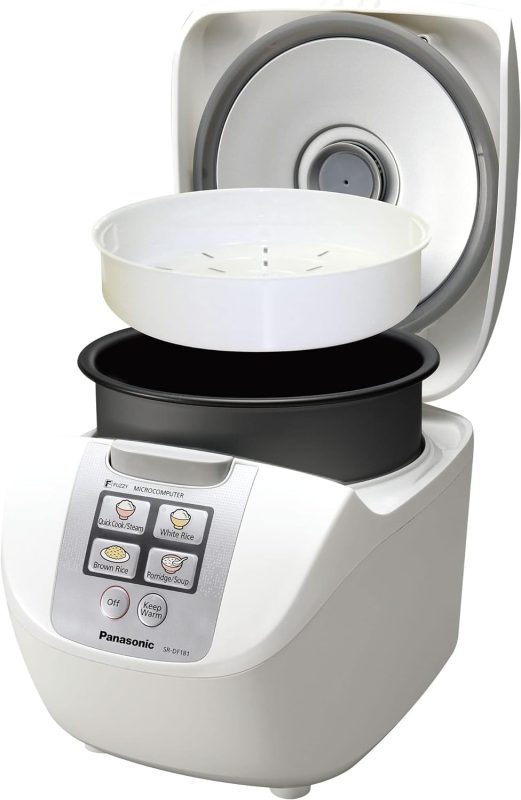
Focus On Long-Grain Texture, Rinsing, Heat Control, And Keep-Warm Behavior.
What Basmati Rice Needs From A Cooker
Long, Separate Grains Are The Texture Target For Many Basmati Meals
Basmati is often rinsed thoroughly and may be soaked before cooking. Those preparation steps can change water absorption, so a cooker that gives clear white-rice or long-grain guidance is more useful than one that simply advertises a large number of presets.
A relevant model for this comparison is Panasonic 5-cup fuzzy logic rice cooker.
Basmati cooks well when the routine is controlled from the start: rinse until the water runs clearer, use a consistent measuring cup, and decide whether soaking is part of the method. A cooker that repeats the same heat cycle reliably is often more valuable than one with a long menu list that does not include a true long-grain program.
Rice Cooker Modes For Basmati
A Dedicated Long-Grain Mode Is Helpful But Not Mandatory
Many cookers handle basmati through a standard white-rice cycle. More advanced models may offer long-grain, texture, or custom controls that make repeat adjustments easier.
A dedicated basmati or long-grain mode is convenient, but it is not essential. Many fuzzy-logic cookers can handle basmati on a standard white-rice cycle when the water method is consistent. Panasonic 5 Cup (Uncooked) Rice Cooker with Fuzzy Logic and One-Touch Cooking for Brown Rice, White Rice, and Porridge or Soup – 1.0 Liter – SR-DF101 (White) and Panasonic 10 Cup (Uncooked) Rice Cooker with Fuzzy Logic and One-Touch Cooking for Brown Rice, White Rice, and Porridge or Soup – 1.8 Liter – SR-DF181 (White) are Panasonic fuzzy-logic examples from the catalog, illustrating that programmable control can be useful without a basmati-specific button.
You can also return to the rice and grain cooking guide.
Rinsing And Soaking
Consistency Matters More Than Copying A Universal Ratio
Rinse and soak the same way when comparing batches. If the cooker manual provides basmati or long-grain instructions, use them before adapting a recipe from another appliance.
The related decision guide is oatmeal and porridge guide.
Rinsing and soaking affect both surface starch and absorbed water. If one batch is soaked for twenty minutes and the next is not, changing the water at the same time makes the result hard to interpret. Keep rinse method, soak time, and cup measure consistent for several batches before deciding the cooker needs a different ratio.
The related decision guide is rice cooker water ratio chart.
Heat Control And Keep-Warm
Long Holding Can Reduce The Light, Separate Texture You Want
A cooker that transitions cleanly to keep-warm is useful, but basmati is often best served without an unnecessarily long holding period. Compare keep-warm behavior and whether the model offers reheat for later servings.
Long-grain basmati is often judged by separation and aroma, so keep-warm deserves attention. A cooker that holds rice for hours may gradually firm the surface or reduce the light texture you want. If meals are served later, compare a model’s reheat function and the manufacturer’s recommended holding window instead of treating indefinite keep-warm as the goal.
Capacity For Basmati Meals
Choose By The Uncooked Batch You Make Most Often
A compact cooker can suit one or two people, while 5- to 6-cup models add flexibility for meal prep and shared meals. Larger capacity is useful only when those larger batches are routine.
Capacity should follow the uncooked amount prepared most often. A compact household can get better results from a smaller vessel that is used near its normal range, while a 5- or 6-cup cooker provides useful headroom for meal prep and guests. Very large capacity is only helpful when those larger batches are routine.
Basmati Rice Cooker Buying Criteria
Rank Features By The Result You Are Trying To Repeat
- Clear white/long-grain program guidance
- Consistent measuring cup and water lines
- Capacity that matches the normal batch
- Keep-warm behavior that does not dominate the routine
- Easy-to-clean pot and lid
- Controls that make small texture adjustments repeatable
For basmati, rank the shortlist by repeatable white- or long-grain cooking, clear measuring guidance, sensible keep-warm behavior, an inner pot that is easy to clean, and a capacity that matches the household. Voice control, app features, or dozens of presets are secondary unless they directly improve that routine.
A useful test batch should be ordinary, not oversized. Cook the amount the household normally eats, note the rinse and soak routine, and judge the rice both immediately and after a short keep-warm period. That reveals whether the cooker supports the real basmati routine better than a one-off maximum-capacity test.
Prioritize consistent heat, clear water guidance, a suitable white-rice or long-grain program, and keep-warm behavior that does not dry the surface too quickly.
