
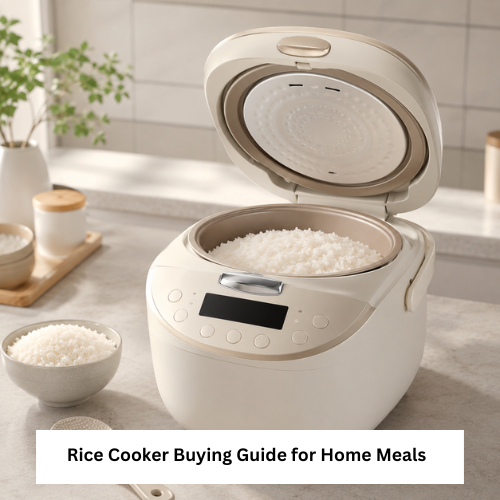
The BuyRiceCookersOnline catalog spans compact, family-size, MICOM, fuzzy-logic, induction, pressure, smart, steaming, low-carb and multi-function rice cookers, so a better purchase starts by defining the meal routine before comparing buttons and feature lists. This guide turns the catalog into a sequence of decisions: capacity first, cooking technology second, pot and cleaning preferences third, then convenience and budget.
A deeper reference for this point is rice cooker size and capacity guide.
Choose Rice Cooker Capacity for Your Household and Portions
Match uncooked capacity to normal meals before feature shopping
Start with the amount of uncooked rice you prepare on an ordinary day. This sounds obvious, but capacity labels often create confusion because listings may show cooked cups, uncooked cups, liters, quarts, or more than one figure in the same title. A cooker labeled “6 cup” cannot be compared safely with another 6-cup model until you know which capacity convention each seller is using.
For one or two people, a compact cooker can reduce counter footprint and unnecessary leftovers. The current catalog includes examples such as a WHITE TIGER 1.0L portable cooker described as 2 cups uncooked and the CUCKOO CR-0375F described as a 3-cup uncooked MICOM cooker. A larger household may prefer the flexibility of 5.5-cup, 6-cup, 10-cup, or larger uncooked capacities, but the best fit still depends on how often you intentionally cook extra rice.
Meal prep changes the calculation. A couple who cooks one dinner at a time may be comfortable with a small pot, while the same household preparing several lunch portions at once may benefit from a larger model. Conversely, buying a large cooker only for occasional guests can mean storing a bulky appliance that is oversized for most meals.
Compare Rice Cooker Technology: Basic, Fuzzy Logic, IH, Pressure & Smart
Compare control systems by the food you actually cook
Technology should be selected for a reason, not because one model has the longest feature list. Basic electric cookers automate heating and switching to warm with minimal controls. MICOM and fuzzy-logic cookers add programmed control and a broader set of cooking decisions. Induction models use induction heating rather than relying only on a conventional bottom heating plate. Pressure models add pressure as another cooking variable, while smart and multi-function cookers can add scheduling, app control, steaming, porridge, soup, slow-cooking, or other programs depending on the model.
For the next level of detail, continue with rice cooker types and technology guide.
The BuyRiceCookersOnline Rice Cookers category contains real examples across that spectrum, including CUCHEN and CUCKOO induction/pressure models, fuzzy-logic cookers, low-carb products with separation baskets, and simple compact models. The right comparison is therefore not “basic versus advanced.” It is “which control system matches the foods and level of involvement I want?”
| Cooking pattern | Technology worth examining | Reason to compare it |
|---|---|---|
| Mostly white rice, simple routine | Basic electric | Fewer controls and straightforward operation may be enough. |
| Several rice or grain types | MICOM / fuzzy logic | Programmed modes may better match varied cooking routines. |
| Premium heat-control priority | Induction heating | Compare heating design, programs, capacity, and price together. |
| Pressure-specific cooking preference | Pressure or twin-pressure models | Evaluate pressure modes, cleaning steps, venting, and controls. |
| One appliance for several tasks | Multi-function / smart | Only valuable when the extra programs will be used regularly. |
Compare Rice Cooker Inner Pot Materials
Nonstick, stainless and ceramic surfaces solve different ownership needs
The inner pot affects cleaning habits, utensil choice, weight, heat behavior, and replacement decisions. Nonstick surfaces can make rice release and cleanup easier, but they require appropriate utensils and care. Stainless-steel or uncoated pots appeal to buyers who prefer a durable metal cooking surface, although rice release and cleanup can feel different. Ceramic-coated pots add another surface option, and the exact coating and care instructions should be checked on the individual product.
For more detail on this topic, use best rice cooker brands guide.
Do not turn material labels into a blanket quality ranking. A well-matched pot is one you are willing to maintain correctly. If you already know that metal utensils will be used, a delicate coating may be a poor fit. If effortless cleanup is the top priority, surface release may matter more. If replacement availability matters, confirm the cooker model and replacement-pot options before purchase instead of assuming any pot with the same capacity will fit.
Rice Cooker Convenience Features Worth Paying For
Timer, keep-warm, steaming and removable parts should solve real routines
Convenience features should remove a recurring annoyance. A delay timer matters if you regularly want rice ready at a planned time. Keep-warm matters when the meal is served after the cooking cycle finishes. A removable inner lid or accessible steam vent can matter more than another preset if the cooker is used every day and cleaning time adds up.
For more detail on this topic, use rice and grain cooking guide.
Steaming is another feature that can be genuinely useful or mostly decorative, depending on the routine. A model such as the Tiger JAX-T10U-K is listed as a 5.5-cup uncooked MICOM cooker with food-steamer and slow-cooker functions. That combination is relevant to a shopper who wants one appliance to handle rice plus simple sides. For someone who never steams food, the same feature should not outweigh easier controls, smaller size, or a better-fitting pot.
Useful when cooking needs to start before you return to the kitchen.
Useful when serving time and cooking completion do not line up.
Useful when frequent cleaning is more important than extra programs.
Useful when side dishes will actually share the appliance.
Useful every single time the cooker is operated.
Useful later, when a pot or accessory eventually needs attention.
Set a Rice Cooker Budget Around Real Cooking Needs
Pay for useful capacity and controls, not unused feature count
Budget works best as a boundary after the cooking requirements are clear. Starting with price alone can push a shopper toward a cooker that is cheap but incorrectly sized, or toward a premium cooker whose advanced modes are never used. Instead, define the must-haves first and compare the simplest models that satisfy them.
Price should also be considered with the ownership details that are visible before purchase: inner-pot replacement options, included accessories, warranty or return information, and any model-specific cleaning requirements. A lower initial price is less useful if the cooker does not fit the household or if a required replacement part is difficult to identify later.
A deeper reference for this point is rice cooker parts and accessories guide.
For buyers working to a firm ceiling, the existing BuyRiceCookersOnline budget-focused content can help narrow the Rice Cookers catalog. The buying guide’s role is different: it should prevent budget from becoming the first and only filter.
Build a Shortlist from the BuyRiceCookersOnline Catalog
Compare the same fields across every final candidate
A strong shortlist should be small enough that the differences are obvious. Three candidates are often easier to compare than twelve. Put the same fields next to each model: uncooked capacity, cooking technology, primary programs, inner-pot material, dimensions, cleaning design, included accessories, and the details you still need to verify.
Eliminate wrong sizes. A technically impressive cooker is still the wrong choice if its normal batch is too small or too large.
Eliminate unused complexity. Remove features that increase cost or learning without solving a routine need.
Compare ownership. Look at cleaning, pot care, accessory fit, support information, and storage.
Verify the listing. Confirm ambiguous capacity, voltage, included parts, and model-specific details before ordering.
The best rice cooker is not the model with the most settings. It is the model whose capacity, controls, materials, maintenance, and price remain sensible after the excitement of the feature list wears off.
